RZ Studio
Building place-based capital
allocation capacity.
CONTEXT
Degenerative Volatility
We are living into an era of degenerative volatility where shocks arrive faster than institutions can adapt and baselines for transformative change (ecological, social, economic, epistemic) are eroding.
WHY
Place-based Resilience
We believe that partners who have spent years building civic legitimacy and proximity to real risk dynamics, in place, are the highest-leverage point for effectively allocating to resilience in the face of degenerative volatility.
HOW
Grafting & Cross-Pollination
Our hunch is that temporarily joining capabilities at critical point of development to provoke and build; and to diffuse new capacities within a small cohort and beyond is one of the most meaningful contributions we can make.
Read more… [coming soon]
WHAT
Embedded Architecture
Together with our partners, we are proposing, testing, and replicating the operating infrastructure — the legal, economic and governance structures that make durable capital allocation into foundational systems possible.
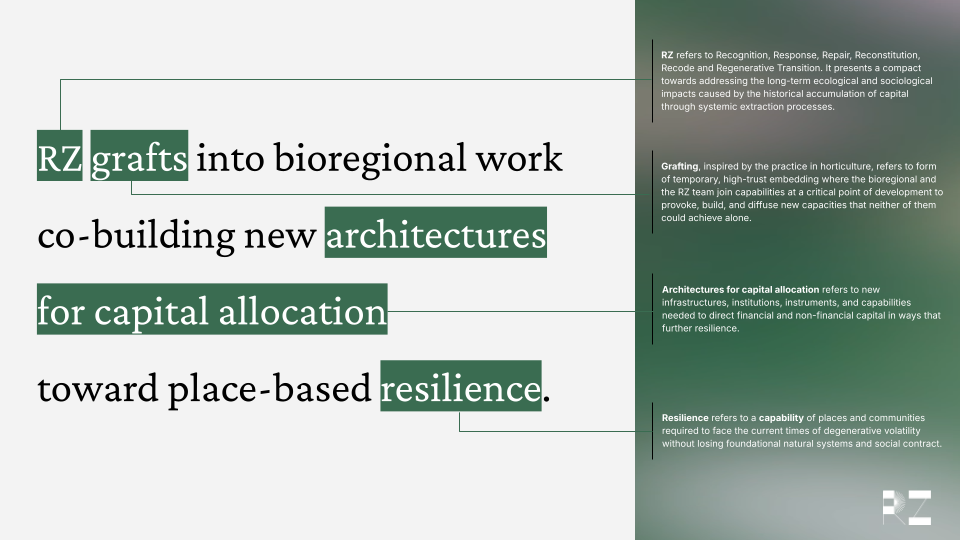
As a studio, we have access to and can contribute to the co-journeying with bioregional teams in a variety of ways.
Co-Creation
Rolling up our sleeves, surfacing the right questions, co-crafting a vision, co-structuring the approach, co-building first prototypes, documenting learnings and process.
Networks
Enabling access to pioneering thinkers and doers across our broad and deep networks, ranging from experts to talent to power holders to resource mobilisers and many others.
Inquiry Capital
Committing an outcomes- responsible amount of inquiry capital to fund the local team’s capacity to lean into the shared inquiry, freeing up existing capacity or bringing in new expertise.
Shared Intelligence
Facilitating cross- learning and sharing of insights between studio partners as well as documenting patterns in abstract form to be re- contextualised elsewhere.
Allocation Capital
Conditionally committing an additional, significant amount of capital, acting as an anchor allocation into new, embedded capital architecture as well as ongoing access to upstream funders.
At RZ, we are on a mission to radically re-code capital allocation.
Together with our place-based partners, we inquire and build into questions such as but not limited to:
- How do we make sense of and better understand planetary risks cascading into the reality of bioregions?
- If we assume that enterprises won’t solve it all, what is the new economic unit to organise and resource this work? What do multi-capital accounting models look like for these economic units?
- How do we create agreement and commitment structures across mass-multi-party collaborations (many-to-many agreements) to inform capital allocation?
- How might we construct and allocate to systemic portfolios across whole bioregions?
- What legal innovation is required to allocate resources to and within bioregions?
- What do ‘returns’ look like in a new place-based allocation paradigm?
- What do ‘blended capital stacks’ look like in this new paradigm?
- What institutional intelligence & adaptive governance need to be built to support it?
- What might wealth stewardship & intergenerational custodianship of resources look like in this work?
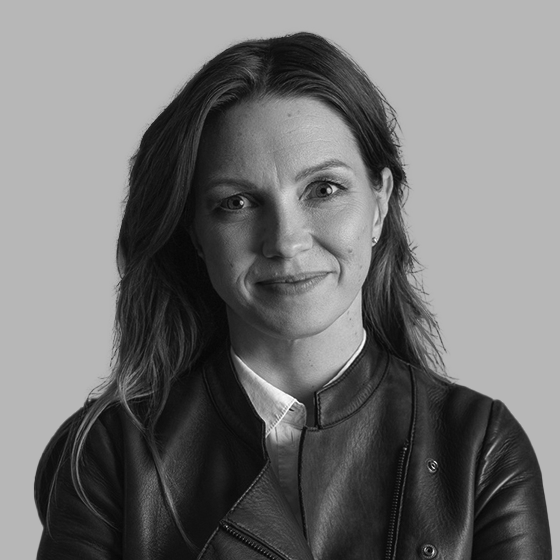
Jen Hooke
Lawyer by training | Re-builder and mentor at heart
Jen is a lawyer by training, and has spent the last ten years building and leading a philanthropic organisation and working in a family office. Prior to this, Jen worked on the technical tax and legal holding structures for wealth. Working across investment and philanthropy has highlighted the need for new allocation pathways, shifts in the role of the allocator and more opportunities for civic asset builders to work at the systems-level. Jen now works on relational infrastructure and governance for system interventions. RZ is at the foreground of this work: supporting the next generation of capital allocators who can bring bold visions, strategic skill and relational experience to cultivate flows of capital that meet the demands of the moment.

Leon Seefeld
Manager by training |
Bioregional Finance designer at heart
Leon is co-leading Dark Matter Capital Systems and managing the project portfolio of the lab. Thematically, he is leading Bioregional Finance in DmCS. Previously, Leon has been working in social innovation and sustainability consulting for several years, among other things, leading his own consultancy firm for regenerative business model innovation and advising on the B Corp certification. He also worked on large-scale landscape restoration projects through weaving multi-stakeholder processes and social labs. Leon holds a Bachelor’s degree in International Business Management and a Master’s in Strategic Leadership towards Sustainability.

Indy Johar
Architect by training | Visionary and provocateur
at heart
Indy Johar is an architect by training, founder of XCO (Expanding Civilizational Optionality), co-founder of Dark Matter Labs and Architecture00, and Professor of Planetary Civics at RMIT University. His work is on the institutional and financial ‘dark matter’ of societal transition — the contracts, capital, and governance systems that decide what can change. He received the London Design Medal for Innovation (2022) and an MBE for services to architecture (2023).

Thao Nguyen
Systems thinker by training | Venture builder at heart
Thao has been on a quest to practice the middle path, both as an individual’s way of living and as a lens to explore the world, eventually finding herself committed to the higher purpose of learning to unite seemingly opposite forces. With a background in entrepreneurship, venture capital, and sustainability, this translates into her conviction of combining doing well (material growth) with doing good (spiritual growth), taking shape as a mission of reinventing markets and capitalism to serve life.
RZ Positions
RZ Definition: the collective capacity required to transform systems
RZ Position
We understand systems transformation to be a collective endeavour. The type of leadership this moment demands of us all is not rooted in founder theory or hero worship, it is rooted in the ability to hold the spaces between us with care.
Large-scale, systems transformation requires systems entrepreneurship, a distinctive capacity to build not only single ventures, organisations or projects, but the coordination conditions that allow multiple interventions, entities, and capital layers to cohere around an outcome. They require an ecosystem of leaders and entrepreneurs acting across different roles, mandates, and time horizons – often spanning public authority, civil society legitimacy, market formation, finance structuring, procurement, regulation, land, infrastructure, and behavioural change. Systems entrepreneurship is the collective capacity required to transform systems.
Links
RZ Definition: the tangible, intangible, and entangled flows of value in motion in a system, catalysed by allocation
RZ Position
We hold the position that every allocation of value, financial or otherwise, realises a return. We explicitly reject the misleading language of return-seeking capital and market-rate returns.
There are always returns. Any intervention, deal, institution, or strategy produces returns somewhere – if not for the actor who intended them, then for others; if not immediately, then over time; if not in money, then in capability, legitimacy, information, or ecological and institutional conditions. Some returns loop back quickly and forcefully to the allocator through a tight, monetised circuit. Other value travels outwards into a wider system, increasing its capacity, resilience, and coherence between returning indirectly, diffusely, or over longer arcs of time. Many of the most consequential returns are longitudinal. They accumulate through trust, capability, ecological health, institutional memory, and social cohesion. These returns develop slowly and compound quietly. Without them, financial returns themselves become fragile.
Allowing returns to circulate outward is therefore not a retreat from self-interest. It is often a more precise expression of it. Circulating returns strengthen the system, increasing its capacity to generate further value. Systems that are healthier, fairer, and more resilient are better hosts for all forms of capital over time. Letting value accrue to others can be a way of stabilising the conditions that make future returns possible at all. The question is less about whether returns exist, and more about the ways that returns can be recognised within a system.
Links
RZ Definition: a condition where variance is persistent, recovery is incomplete, and the system’s capacity to restore order declines over time
RZ Position
We recognise the urgency and necessity to stabilise systems – relational, ecological, cognitive, financial – before it is too late. Recognising the urgency, we move with care and deep intention.
Crises are accelerating and compounding. Macro-level disruptions are creating increasingly rapid and unpredictable shocks across economic, ecological, and social systems. We are no longer speaking of volatility where a system oscillates around a recognisable mean – the baseline itself is falling away. The key feature is not the shock, but the shrinking ability to reset between shocks. Disturbances recur before recovery completes. Maintenance backlogs accumulate. Attention is consumed by triage. Reserves are depleted and not rebuilt.
Degenerative volatility is therefore measurable in a simple way: when the interval between shocks is shorter than the time required to recover, the system becomes structurally fatigued. In that fatigue, buffer capacity – fiscal, ecological, institutional, infrastructural, social – is spent merely to keep functioning.
Links
RZ Definition: the ability of a system to continue, renew, stabilise, and/or adapt without cascading into runaway volatility
RZ Position
We recognise there is no wall high enough, no fortress large enough, no weapon powerful enough to divide ourselves from the world and make ourselves more secure. There is no ‘us’ without ‘them’. We are indivisible.
A bounded view of security looks to divide, insulate and protect from the world. In a systems view of security the goal space is continuity. The ability of a system to continue to provide foundational goods – energy, food, water, cognitive thinking, connection – even in the face of large-scale shocks and volatility.
Links
RZ Definition: holding a position with enough strength and flexibility to create the space for others to come in alongside
RZ Position
At the RZ Studio we back collective leadership creating the enabling conditions for futures worth building. We recognise our own power as co-stewards of these futures and hold the responsibility to show up with the full breadth of our resources.
We come alongside partners to accelerate their own commitment, where it matches our capabilities and intentions. This follows the principled idea of Power-with.
Links
Power Cannot Be Allocated: Designing Organizations for a Complex World
RZ Definition: holding open, at the same time, (1) what the situation actually requires (systemically, structurally — “the necessary”) and (2) what conditions, resources, or politics currently allow (“the possible”) — without letting either one collapse the other.
RZ Position
We fundamentally believe that despite the constraints of the possible, a stretch toward to necessary is needed. We treat near-term, concrete goals that build on the possible as entry points. That goals are what makes the larger work politically and financially possible: they are legible enough to mobilise partners, capital, and institutional will where none previously existed. But the real product is the systemic capability built in getting there — capacity that can be carried into the next intervention, and the one after that.
RZ’s position, in this sense, is that the possible and the necessary are held together continuously, with each concrete option acting as the mechanism that keeps the necessary within reach of the possible.
Links
RZ Definition: directing resources towards the conditions from which future value, resilience and possibility can emerge.
RZ Position
We see capital allocation as an active form of systems design. Every allocation shapes the conditions around it: what gets resourced, which risks can be taken, whose capabilities develop, and where value accumulates over time. The allocator therefore has a role beyond selecting investments and managing a portfolio. They participate in shaping the systems in which those investments sit.
We are interested in building the infrastructure that allows capital to be allocated at the scale and complexity at which systemic risks actually unfold.
Links
RZ Definition: holding risk alongside partners rather than shifting, compliancing, diligencing, or hedging it away
RZ Position
At RZ, we believe that capital allocation often works by trying to make uncertainty disappear: through diligence, contractual transfer, risk pricing, covenants, insurance, guarantees and exit mechanisms. These are important tools, but they have limits when dealing with complex and evolving systems where the risk itself is only partially knowable.
RZ takes a different position. We seek to hold risk alongside our partners: committing resources, sharing exposure, staying engaged as circumstances change, and building the intelligence required to understand what is emerging. This means taking responsibility for the uncertainty inherent in developing new architectures rather than designing structures that simply transfer it to those with less capacity to carry it.
For RZ, Holding Risk is therefore a form of developmental capital. It creates the time and space for new knowledge, capability and institutional arrangements to emerge. The objective is not to eliminate risk, but to build the capacity of the system to recognise, absorb and respond to it over time.
Links